What really happens during a Trager session
— Association Trager Québec
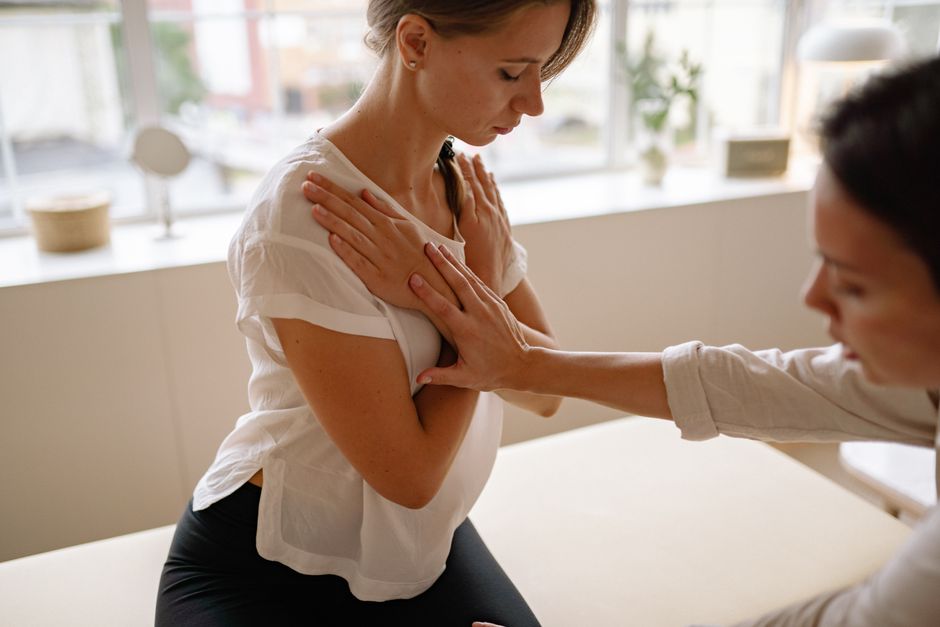
The question we hear most often before a first session is a simple one: "What exactly is going to happen?" The Trager approach surprises people because it is neither a massage nor an exercise. Here, step by step, is what you will experience with a certified Trager practitioner, and what you can expect from it.
Before you begin: a few questions and comfortable clothes
The session opens with a short conversation. The practitioner first assesses your state of health by asking you a few questions. This is the time to mention any pain, recent surgery or particular condition: the practitioner always adapts the range of the movements to the condition, needs and age of the person receiving.
Trager is practised without oil or lotion. You can therefore remain partly or fully clothed, as long as your clothes are comfortable. The session is usually given lying on a massage table, but it can also be given on a chair. For people with reduced mobility, it can take place in bed, lying on one side, or in a wheelchair.
Allow enough time: a Trager session lasts on average an hour and a quarter.
During the session: gentle movements, never forced
Once you are settled, the practitioner gently lifts and mobilizes the various parts of your body, one after another, in a soft and steady rhythm. There is no kneading, no cracking of joints and no pressing on painful spots. Instead, the practitioner uses:
- swaying and rocking;
- rotations and undulations;
- light compressions;
- light stretches and vibrations.
These movements follow a rocking rhythm specific to each person. They create a safe context that invites the restful experience of letting go. In the words of the association's texts, "Trager movements create waves whose resonance spreads through the body, loosening and lightening the body as much as the mind."
For your part, there is nothing to do. The receiver lets themselves be rocked and carried along by the gradual flow of the movements. As the nervous system calms down, the muscles relax and tensions fade. Many people then (re)discover how freely and lightly their body can move.
Respecting the body's limits is part of the approach. When an area is inflamed, for example, the practitioner does not mobilize it like the others: the same principles of well-being are applied, with very small movements, without trying to go far.
What the practitioner is looking for: a sensation, not a correction
This is what sets the Trager approach apart the most. Developed by Dr. Milton Trager, this mind-body approach is based on movement re-education and aims to reach the mind through the body. The idea is to convey, through touch and certain mobilizations, what the tissues offer in their ideal state.
The practitioner does not work "against" a tension. They are guided by an open question, the one Milton Trager asked himself: what could be lighter, easier? They also work from a state of calm and presence that Milton Trager called Hook-up. As our texts put it: "The foundation of the Trager approach is a meditative state, which Milton Trager called Hook-up, a state of calm and peace that the practitioner passes on to the client."
Discovering these "comfort zones" signals to the central nervous system that there are many options for countering the poor postures and habits that cause tension and restriction in daily life. An article in the magazine Mieux-être (2008) put it this way: rather than treatment, it is more a matter of teaching.
After the session: relaxation that lasts
The feeling does not stop at the door. Body and mind remember these new positive experiences, which can then be found again and deepened from one session to the next. Mieux-être even suggested allowing a few extra minutes after the session to talk with the practitioner and "come back down to earth". The benefits are felt from the very first session and are cumulative: further sessions bring deeper and longer-lasting effects.
At the end, the practitioner may teach you a few simple, light and effortless movements called Mentastics. They let you continue the effect of the session on your own, every day. You can also explore them in a group or in an individual session.
Keep in mind that the Trager approach does not diagnose and does not replace medical care: it accompanies. The people who practise it are not called therapists, but practitioners. They are trained to recognize situations that should be referred to a health professional.
Frequently asked questions
Do I need to undress?
No. Since Trager is practised without oil or lotion, you can stay partly or fully clothed, in comfortable clothes.
How long does a session last?
An hour and a quarter on average. A session can be given on a table or on a chair, and it can be adapted to reduced mobility (in bed, lying on one side or in a wheelchair).
How much does a session cost?
Rates are not published by the association. Please ask the practitioner of your choice directly.
Experience your first session
The best way to understand the Trager approach is still to receive it. Choose a certified practitioner near you in our practitioner directory, or first take the time to discover the approach in detail. If you would rather start with movement, Mentastics groups are a lovely way in.